Introduction
If you’ve ever looked at your electricity bill and spotted a DNO region code or a long number called an MPAN, you might have wondered what they mean. These codes show which Distribution Network Operator (DNO) delivers power to your home or business, and they can even affect what you pay on certain tariffs.
Use this guide to find your DNO region code in seconds. Check it by postcode or MPAN, see all 14 UK DNO codes (A–P), and learn who runs your local electricity network.

Table of Contents

What Is a DNO?
A DNO (Distribution Network Operator) is a licensed company that owns and maintains the electricity network in a specific UK region. They manage the cables, substations, and infrastructure that deliver power from the National Grid to your property.
⚡ Important: Your electricity supplier (like Octopus, EDF, or British Gas) bills you for energy, but your DNO delivers the electricity.
What Does DNO Stand For?
DNO = Distribution Network Operator.
It’s not your supplier, but the company responsible for the physical delivery of electricity in your area
How Many DNOs Are There in the UK?
The UK is divided into 14 licensed DNO regions, but they are operated by just six main company groups (UK Power Networks, Northern Powergrid, SP Energy Networks, SSE, Electricity North West, and National Grid).
There are also Independent Distribution Network Operators (IDNOs) who run smaller networks, often for new housing estates or developments.
What Are DNO Region Codes and Why Do They Matter?
Each DNO region is given a unique letter code (A–P).
These codes are used in electricity systems, on MPAN numbers, and by energy suppliers to set region-specific tariffs.
For example, rates on the same tariff can vary slightly depending on your DNO region code. More expensive in some areas, cheaper in others.
UK DNO Region Codes (A–P List and Map)
Here’s the full list of UK DNO region codes:
| DNO Code | Region | Operator Group |
|---|---|---|
| A | Eastern England | UK Power Networks |
| B | East Midlands | National Grid (WPD) |
| C | London | UK Power Networks |
| D | Merseyside & North Wales | SP Energy Networks |
| E | West Midlands | National Grid (WPD) |
| F | North East England | Northern Powergrid |
| G | North West England | Electricity North West |
| H | Southern England | SSE |
| J | South Eastern England | UK Power Networks |
| K | South Wales | National Grid (WPD) |
| L | South Western England | National Grid (WPD) |
| M | Yorkshire | Northern Powergrid |
| N | Southern Scotland | SP Energy Networks |
| P | Northern Scotland | SSE |
Map of UK DNO Regions (UK DNO MAP)
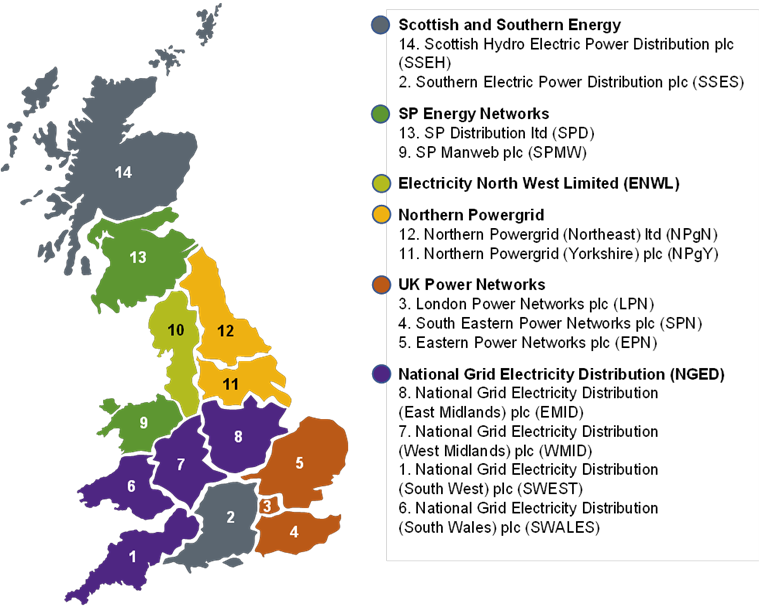
Map of electricity distribution networks in Great Britain.
Source: Ofgem, reproduced via UKERC – Regulating electricity distribution networks for net zero (licensed under CC BY-NC-ND 4.0).
How to Find Your DNO Region Code (Postcode or MPAN)
You can identify your DNO and region code in three main ways:
1. On Your Electricity Bill (using your MPAN)
Your MPAN (Meter Point Administration Number) is a 21-digit number that uniquely identifies your electricity supply. It usually looks like this on your bill:
-
The top line is called the “Distributor ID.”
-
The first two digits of this line tell you which DNO region you are in.
2. By Postcode (who is my dno by postcode)
You can use the Energy Networks Association postcode lookup to find your DNO directly.
3. By Phone
Call 105 (free from any phone) to be connected to your local DNO — especially useful in a power cut.
MPAN Distributor ID Codes and DNO Region Map
Here’s the accurate, up-to-date mapping between the first two digits of your MPAN, the DNO letter code, and your operator:
| MPAN First 2 Digits | DNO Region Code | Region | DNO Operator |
|---|---|---|---|
| 10 | A | Eastern England | UK Power Networks |
| 11 | B | East Midlands | National Grid (WPD) |
| 12 | C | London | UK Power Networks |
| 13 | D | Merseyside & N. Wales | SP Energy Networks |
| 14 | E | West Midlands | National Grid (WPD) |
| 15 | F | North East England | Northern Powergrid |
| 16 | G | North West England | Electricity North West |
| 17 | P | Northern Scotland | SSE |
| 18 | N | Southern Scotland | SP Energy Networks |
| 19 | J | South East England | UK Power Networks |
| 20 | H | Southern England | SSE |
| 21 | K | South Wales | National Grid (WPD) |
| 22 | L | South West England | National Grid (WPD) |
| 23 | M | Yorkshire | Northern Powergrid |
👉 Example: If your MPAN starts with 23, your DNO is Northern Powergrid, your region code is M, and your region is Yorkshire.
Live Agile Prices by DNO Region (Octopus API)
You can view the latest Octopus Agile prices for any region by changing the region letter at the end of the tariff code in the API URL. The region letters match the DNO region codes (A–P) listed above.
Example – South Western England – Letter Lhttps://api.octopus.energy/v1/products/AGILE-24-10-01/electricity-tariffs/E-1R-AGILE-24-10-01-L/standard-unit-rates/
🔎 Note: The L at the end of the tariff code selects South Western England.
Switch to London – letter C
Just change the final letter to Chttps://api.octopus.energy/v1/products/AGILE-24-10-01/electricity-tariffs/E-1R-AGILE-24-10-01-C/standard-unit-rates/
You can replace the product code with any Octopus tariff. e.g. AGILE-24-10-01 or INTELLI-VAR-24-10-29
See the Octopus Developer API documentation for more details.
Other Octopus Energy Smart Tariffs
Explore more time-of-use tariffs in our Time-of-Use Tariffs hub. Quick overview:
-
Agile — half-hour day-ahead pricing that tracks wholesale costs.
-
Cosy — time-bands for cheaper heating periods.
-
Go — overnight EV charging at low rates.
-
Flux — export-friendly for home solar/battery users.
-
Intelligent Go — smart-scheduled EV charging at cheap times.
-
Tracker — daily variable unit rate linked to wholesale benchmarks.
- Wholesale Energy Pricing – how wholesale prices can be derived from Agile rates.
Tip: these tariffs reward shifting usage to off-peak times — good for bills and for a more renewables-friendly grid.
Looking for a full breakdown of these tariffs? Check out our Time-of-Use Tariffs hub, where we compare Agile, Cosy, Go, Flux, Intelligent Go, and Tracker side by side and explain how each one works.
If you switch to Octopus Energy using my referral link, you can claim £50 FREE credit. Thank you if you do!
Why DNO Region Codes Matter for Tariffs and Connections
Knowing your DNO region code is useful for:
-
Smart tariffs & regional pricing → Tariffs like Octopus Agile use DNO region codes to set half-hourly prices.
-
Power cuts → You contact your DNO (not your supplier) if the electricity goes out.
-
New connections → Applications for solar, batteries, or EV chargers are handled by your DNO
DNO vs IDNO: Key Differences Explained
-
DNOs → Cover large, licensed UK regions (the 14 listed above).
-
IDNOs (Independent Distribution Network Operators) → Smaller licensed companies that extend or build new networks, often for housing estates, commercial sites, or renewable projects.
What Is an IDNO?
An IDNO (Independent Distribution Network Operator) is a company licensed by Ofgem to own and operate smaller electricity networks. Unlike the 14 regional DNOs, which cover large areas of the UK, IDNOs usually:
-
Build and operate new networks for housing developments, business parks, and renewable projects.
-
Connect to the main DNO network, but manage the local extensions.
-
Set their own network charges, though these are regulated by Ofgem to stay fair.
IDNO vs DNO – Key Differences
| Feature | DNO | IDNO |
|---|---|---|
| Coverage | 14 large licensed regions (A–P codes) | Local networks (housing estates, commercial parks, renewables) |
| Ownership | Operated by 6 main groups (e.g. UK Power Networks, SSE) | Smaller licensed operators (e.g. ESP Electricity, GTC, Energetics) |
| Regulation | Licensed and regulated by Ofgem | Also Ofgem-licensed, but with limited areas |
| Customer impact | Deliver power, manage faults/outages | Manage supply in new/embedded networks |
Who Are the Main IDNOs in the UK?
Here are some of the main IDNOs licensed by Ofgem:
| IDNO Company | Typical Focus | Notes |
|---|---|---|
| ESP Electricity | Residential developments | One of the largest IDNOs, serving thousands of new-build homes. |
| GTC (The Gas Transportation Company) | Residential & mixed-use | Long-established, operating both gas and electricity embedded networks. |
| Energetics Electricity | New housing & business parks | Strong presence in Scotland and northern England. |
| Vattenfall IDNO | Renewable projects & developments | Part of Swedish energy group Vattenfall, focuses on clean energy connections. |
| Harlaxton Energy Networks | Commercial & housing | Works on industrial parks and housing estate networks. |
| Leep Utilities | Multi-utility networks | Provides electricity, gas, water, and heat networks. |
| Independent Power Networks (IPNL) | Residential estates & mixed sites | Known for operating embedded networks across England. |
Summary: DNO and IDNO Region Codes at a Glance
-
DNO = Distribution Network Operator
-
The UK has 14 DNO regions, each with a letter code (A–P).
-
IDNOs are smaller, Ofgem-licensed operators that run new or embedded networks.
-
Find your DNO via MPAN, postcode, or by calling 105.
-
Region codes affect tariffs, supply, and who you call in a power cut.
By understanding your DNO region code (and IDNOs where relevant), you can quickly identify your local network operator, get the right contact in an outage, and understand why your electricity prices vary by region.
Frequently Asked Questions (DNO & IDNO FAQs)
What is a DNO supply?
A DNO supply means electricity delivered to your property by your local Distribution Network Operator. Your DNO owns and maintains the cables and substations that carry power from the National Grid to your home or business.
Who is my DNO by postcode?
Enter your postcode into the Energy Networks Association lookup tool or call 105 to find your local DNO. Both methods work anywhere in the UK.
What is the difference between a DNO and a supplier?
Your supplier (for example Octopus, EDF, or British Gas) sells you energy and sends the bills. Your DNO owns the network that physically delivers the electricity to your property.
What is an MPAN and how does it link to DNO codes?
An MPAN (Meter Point Administration Number) is a unique number that identifies your electricity supply. The first two digits of the Distributor ID section reveal which DNO covers your region.
How many DNO region codes are there?
There are 14 DNO region codes in the UK, labelled A to P. Each one represents a licensed electricity network area.
How do I know if I’m with an IDNO or a DNO?
Most homes are connected through a DNO, but some new-build developments use an IDNO.
-
Check your electricity bill — the MPAN may show an IDNO distributor ID.
-
Ask your supplier — they can confirm your network operator.
-
Call 105 — the system connects you to the right operator automatically.
Who do I call in a power cut?
Dial 105 (free from any phone) to reach your local DNO or IDNO. They manage the network and can give updates during outages.
Why are electricity prices different by region?
Each DNO has its own network costs, so tariffs vary slightly across the UK. Suppliers use your DNO region code to calculate local pricing.
Is there a map of UK DNO regions?
Yes. The UK electricity network is divided into 14 DNO regions, each with a letter code from A to P. See the map above for coverage.
Referral information and free credit offer
If you find Energy Stats UK useful, there are a couple of easy ways to support the site and help cover hosting and server costs.
Thinking about switching energy suppliers?
Homeowners who join Octopus Energy using my referral link get £50 free credit after signing up. Business users get £100 free credit, and if you’re looking at solar or a heat pump, there’s also a £100 gift card through Octopus Tech.
Finally, a £25 gift card can be claimed when having an EV charger installed through Octopus.
“Existing Octopus customer? Find out how you can benefit too. T&Cs apply (only one switching offer per household)”
You can switch to E.ON Next with this code and switch to EDF (FreePhase) with this code.
Or, if you just want to say thanks, you can buy me a coffee.
You can also see more ways to support the site here via the likes of Plusnet broadband, Smarty Mobile, Havenwise remote heat pump control, Axle Energy, Quidco and more.
If you are thinking about a heat pump, check out my dedicated Trusted Heat Pump Installers website along with my guide How to Choose a Heat Pump Installer.
Follow @energystatsuk on Twitter / X, Bluesky and Mastodon for daily tariff graphs and updates.
Also, check out my Energy Unwrapped Podcast and please subscribe to my YouTube channel where podcast episodes and video articles will be published.
Note: The current and past performance of energy pricing is not necessarily a guide to the future.