
Solar export rates cut to 12p. And it may only get worse
The recent move by Octopus Energy to cut export payments from 15p to 12p from 1st March 2026 has caught a lot of people’s attention.
On the face of it, it feels like a step backwards for solar owners. But when you look at the underlying market data, the change starts to make sense.
I am honestly surprised the rate has not fallen further than 12p per kWh.
I’ve pulled together my full Agile Outgoing dataset for 2024, and the pattern is pretty clear. Flat export rates were already looking stretched, especially through the summer months.
TLDR: Export rates have fallen from 15p to 12p because the market was already clearing much lower in 2024. My data shows most solar exports happen when the grid least needs them, while early evening power is worth far more. Expect growing pressure on flat export rates and more focus on demand-led tariffs.
The accompanying video with added commentary
I have uploaded the following video to my YouTube channel where I talk through the article and add further commentary and thoughts to the original text.
Hope you find this type of content useful.
Like and subscribe to get notified of more videos.
Export tariff versions explained
There are two versions of export tariffs available from Octopus Energy:
-
Outgoing Variable tariff
-
Outgoing Agile tariff
The Variable tariff pays a fixed price throughout the day, regardless of when you export back to the grid.
The Agile variant works like its import cousin (Agile import). The price changes every 30 minutes, giving 48 different time slots per day.
You can find full details and regional pricing on the Outgoing Export tariff pages.
The export rate reality check from 2025
Across the whole of 2025 in my dataset:
-
Average export price: 9.2p/kWh
-
Median export price: 8.7p/kWh
-
83.8% of half hours were below 12p
-
92.0% were below 15p
That alone tells you something important. The market is still clearing well below both the old 15p rate and the new 12p rate most of the time.
You can see in both these graphs how the export rate has consistently been lower than both the 15p and 12p markers for most of 2025.


So if the Agile export price, which is based on the wholesale value of electricity in that half hour, is usually well below 15p, how can a flat 15p rate remain good value for the supplier?
Looking back: 2024 was just the same
This pattern did not suddenly appear in 2025.
From my full 2024 dataset:
-
Average export price: 8.4p/kWh
-
86.6% of half hours were below 12p
-
94.3% were below 15p
In other words, the pressure on flat export tariffs has been building for a while.

Summer is where the pressure really shows
The real stress point is summer. That is when most homes export the most, and when wholesale prices tend to be weakest.
From my June to August data:
2025 summer
-
Average export price: 8.5p/kWh
-
Nearly 88% of half hours were below 12p
2024 summer
-
Average export price: 7.9p/kWh
-
Nearly 89% below 12p

This is the uncomfortable truth. The grid is often already well supplied during sunny midday periods. Paying a generous flat rate during those hours becomes harder to justify over time.
Why flat export rates are under pressure
Suppliers are not charities. Ultimately, export payments have to relate in some way to what that energy is worth in the wholesale market.
Yes, companies can run loss-leading tariffs for customer acquisition. We have seen that before. But doing that at scale, year after year, gets expensive quickly.
When wholesale spends long periods in single digits, the headroom to keep paying 15p shrinks.
The move to 12p looks much more aligned with where both 2024 and 2025 wholesale pricing has been sitting.
How Agile Outgoing relates to wholesale prices
Outgoing Agile is closely linked to the wholesale electricity market, but it is not simply the raw wholesale price passed straight through.
Each half hour, Octopus sets the Agile export price using a formula based on the day-ahead wholesale market. The aim is to reflect the real market value of electricity in that settlement period.
In simple terms:
-
Wholesale rises → Agile export usually rises
-
Wholesale falls → Agile export usually falls
-
Very low wholesale periods feed through to weak export pricing
This is why Agile Outgoing provides a useful real-world benchmark for what exported solar is actually worth.
Octopus Outgoing Export Rates Today
You can find today’s Octopus Outgoing Export tariff rates in two ways
- Via the 14 separate pages (one per region) linked above.
- Via the daily post on social media (Twitter / X, Bluesky or Mastodon)
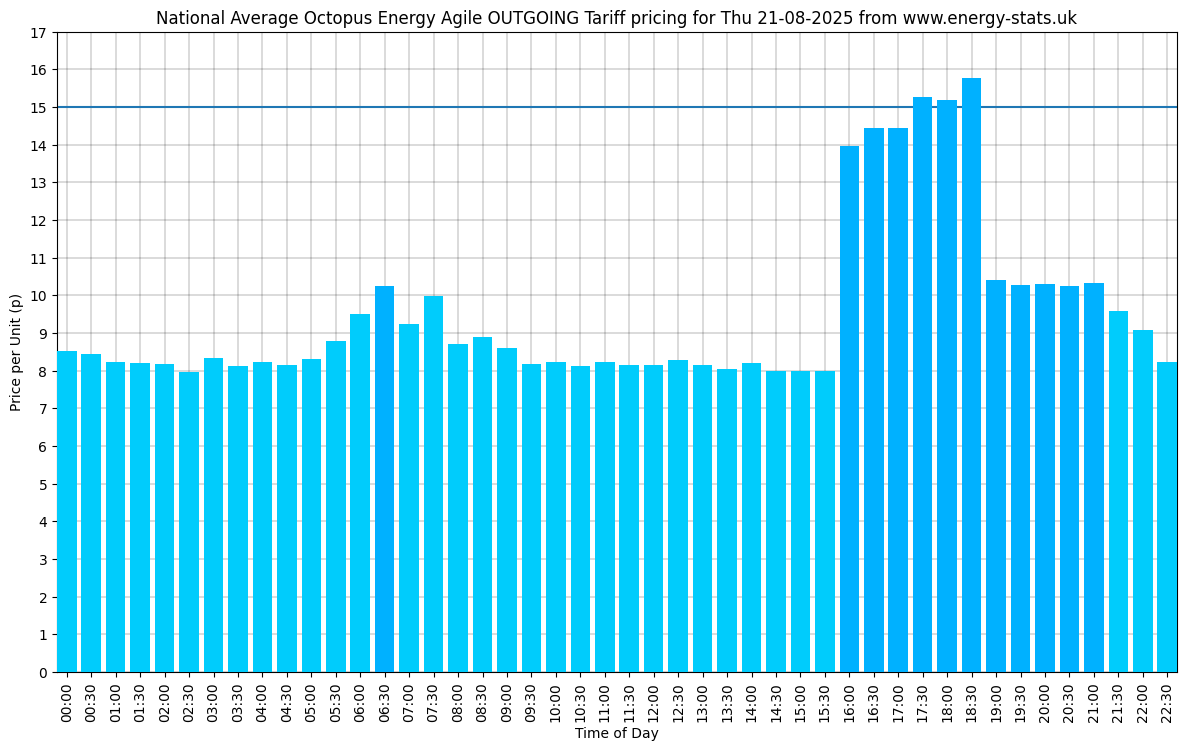
This image shows the latest Octopus Outgoing Agile Export graph that is posted to social media every day.
Subscribe to get this graph and more (Greener Days, Octopus Agile, Octopus Tracker etc)
; ?>)

Is it “madness” that 15p exports ever existed?
It was always slightly odd that you could get paid 15p per kWh to export at lunchtime in July when the grid was often already awash with solar.
The recent move to 12p suggests suppliers are starting to realign export payments with real market conditions.
Based on both the 2024 and 2025 data, that pressure does not look like it is going away.
This change has been on the cards for a while
Both myself and Gary (from Gary Does Solar) have been warning of this change for some time.
Just one week before the rate was announced, Gary and I mentioned the seemingly out of touch outgoing rate on our recent chat on my podcast (Energy Unwrapped with Mick Wall).
You can view that episode here.
The podcast is available on video via YouTube and via audio on Spotify and Apple Podcasts.
Don’t forget to like and subscribe. Thank you.
The bigger shift: not all export is equal anymore
There is a structural change happening in the electricity system.
Most domestic solar exports occur:
-
Around midday
-
In spring and summer
-
When the grid is already well supplied
But what the system increasingly needs is flexibility and power during the late afternoon and early evening peak.
My data shows this very clearly.
2025 averages (UK time):
-
Midday: 7.5p/kWh
-
4pm to 7pm peak: 16.1p/kWh

In simple terms, the grid often values energy far more in the early evening than it does at lunchtime.
Why Agile Outgoing starts to make more sense
This is where demand-led export tariffs come into their own.
A flat export tariff:
-
Pays the same at 1pm in July
-
Pays the same at 5pm on a cold evening
-
Ignores system conditions
Agile Outgoing is different. It tracks the market and tends to reward export when the system is tighter.
Put bluntly, it pays more attention to when the grid actually needs the energy.

Not every household can take advantage of this, but the direction of travel is pretty clear.
What falling export rates mean in real money
It is easy to talk about export rates in pence per kWh, but what most homeowners really want to know is the cash impact.
The table below shows how annual export income changes at different tariff levels.
| Annual export (kWh) | 15p | 12p | 10p | 8p | 6p |
|---|---|---|---|---|---|
| 1,000 | £150 | £120 | £100 | £80 | £60 |
| 2,000 | £300 | £240 | £200 | £160 | £120 |
| 3,000 | £450 | £360 | £300 | £240 | £180 |
| 4,000 | £600 | £480 | £400 | £320 | £240 |
| 5,000 | £750 | £600 | £500 | £400 | £300 |
| 6,000 | £900 | £720 | £600 | £480 | £360 |
| 7,000 | £1,050 | £840 | £700 | £560 | £420 |
| 8,000 | £1,200 | £960 | £800 | £640 | £480 |
Key takeaway:
Every 3p drop in export rate costs roughly £30 per year for every 1,000 kWh exported.
Batteries changes the game
If you have battery storage, this shift becomes even more relevant.
Instead of exporting everything at lunchtime when prices are weak, you can:
-
Store excess solar
-
Hold it through the afternoon
-
Export later when prices are stronger
That behaviour is exactly what the future grid needs more of.
Round-trip losses: the hidden profit killer
A popular tactic, especially on EV tariffs like Intelligent Octopus Go, has been battery arbitrage.
Charge cheap overnight. Export high later. Pocket the difference.
In theory, simple.
In practice, round-trip losses eat into the margin.
On many AC-coupled systems, real-world round-trip efficiency can be around 80 to 85 percent, meaning:
-
You buy 1 kWh
-
You only get about 0.8 to 0.85 kWh back out
As the gap between cheap import and export narrows, this matters a lot more.
When the spread was roughly 7p buy vs 15p sell, arbitrage still worked comfortably.
But with the latest pricing:
-
Intelligent Octopus Go around 7.5p
-
Octopus Go around 9p
-
Export falling to 12p
…the maths is getting tight.
For many households, simple timer-based arbitrage is now marginal at best once losses and wear are considered.
Try the arbitrage calculator
Battery arbitrage calculator (with round-trip losses)
Notes: Profit is calculated per kWh charged from the grid. Annual throughput = daily kWh × days per year. Only efficiency × kWh is available to sell later.
This shows whether buy-low sell-high cycling is still profitable once you include round-trip losses and optional battery wear.
When arbitrage still makes sense
There are still scenarios where battery shifting can work well:
-
Agile import users catching very low prices
-
Strong evening export pricing
-
Smart automated control of charge and discharge
Tools like Predbat, and newer AI-driven battery systems, are becoming increasingly important here.
A quick note on “brown exports”
You may start to hear the term brown exports used in the energy community.
This typically refers to electricity exported from a home battery that was originally charged from the grid, rather than directly from on-site solar generation (sometimes called “green exports”).
From a settlement point of view, the grid generally sees exported units the same way. But from a system and policy perspective, the distinction may become more relevant over time, particularly as battery arbitrage grows.
For now, the key takeaway is simple: if you are exporting energy that was first bought from the grid, round-trip losses and tariff spreads matter even more to the economics.
Do solar diverters become viable again?
For many years I stopped using our myenergi Zappi EV charger to send surplus solar generation to the car.
Why would I, when I could charge the car for 7p overnight and then get 15p for sending the solar back to the grid.
But as the price gap between import and export closes, do solar diverters become viable again?
EV chargers like the myenergi Zappi and their hot water diverter, the Eddi could well become flavour of the month again.
All talking to that ‘self consumption’ model.
What this means for solar owners
A few practical takeaways.
1. Expect export rates to remain under pressure
Midday solar oversupply is not going away.
2. Self-consumption is still king
Using your own solar directly will usually beat exporting it.
3. Batteries become more valuable when used smartly
Especially if you can shift energy into the evening peak.
4. Demand-led tariffs are likely to grow in importance
Agile-style export fits better with how the grid is evolving.
5. Be cautious modelling ROI on export rates
Future export pricing is far from guaranteed.
Final Thought
Export payments are not disappearing. Even at 12p, they still add up over a year.
But the easy era of generous flat export rates is fading. Both 2024 and 2025 data point in the same direction.
As the system fills up with cheap midday solar, the real value is increasingly in flexibility and timing, not just raw generation.
Being rewarded when the grid actually needs your energy is likely to matter more and more from here.
Whilst Octopus Energy have been the first of the big suppliers to make this reduction in export payments, it will be interesting to see if the others follow.
Referral information and free credit offer
If you find Energy Stats UK useful, there are a couple of easy ways to support the site and help cover hosting and server costs.
Thinking about switching energy suppliers?
Homeowners who join Octopus Energy using my referral link get £50 free credit after signing up. Business users get £100 free credit, and if you’re looking at solar or a heat pump, there’s also a £100 gift card through Octopus Tech.
Finally, a £25 gift card can be claimed when having an EV charger installed through Octopus.
“Existing Octopus customer? Find out how you can benefit too. T&Cs apply (only one switching offer per household)”
You can switch to E.ON Next with this code and switch to EDF (FreePhase) with this code.
Or, if you just want to say thanks, you can buy me a coffee.
You can also see more ways to support the site here via the likes of Plusnet broadband, Smarty Mobile, Havenwise remote heat pump control, Axle Energy, Quidco and more.
If you are thinking about a heat pump, check out my dedicated Trusted Heat Pump Installers website along with my guide How to Choose a Heat Pump Installer.
Follow @energystatsuk on Twitter / X, Bluesky and Mastodon for daily tariff graphs and updates.
Also, check out my Energy Unwrapped Podcast and please subscribe to my YouTube channel where podcast episodes and video articles will be published.
Note: The current and past performance of energy pricing is not necessarily a guide to the future.

