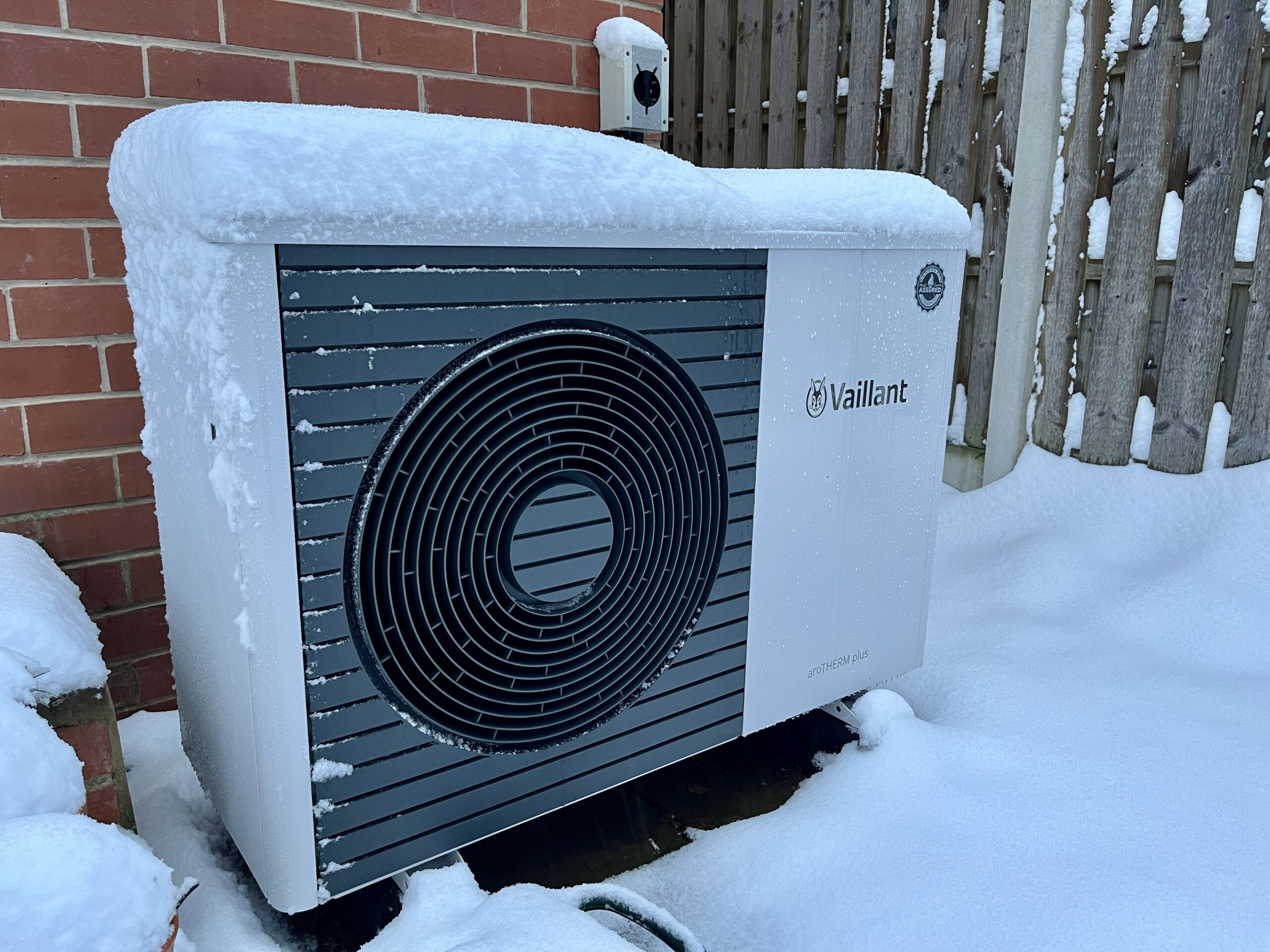
Featured Summary
UK winter heat pump COP changes with outdoor temperature.
In my data from a full UK winter, my heat pump produced around 5 kWh of heat per 1 kWh of electricity at about 8 °C outside, but only around 3 kWh of heat per 1 kWh of electricity at 0 °C.
Most gas boilers stay close to the same efficiency in all weathers, but heat pumps vary because they pull heat from the outside air. The colder it gets, the harder the heat pump has to work.
But don’t let this put you off, because as the data shows, a typical UK winter spends most of its time between 5 °C and 10 °C, which means a heat pump can run at the higher end of its performance range for long stretches of the season.

Table of Contents
Use the Table of Contents below to jump straight to the section that matters most or scroll through at your own pace.
This article is part of my wider series of Vaillant Arotherm and heat pump guides, aiming to demystify the settings that matter most for efficiency and comfort.
Vaillant Arotherm Heat Pump Guide & User Manual
Heat Pump Efficiency Through a UK Winter
In this short article I’ll go through real world UK winter heat pump COP data from my own system and show how outside temperature links to COP, heat output and electricity use.
Heat pump performance drops as the weather gets colder. This is obvious to people who have lived with a heat pump for a while, but it can come as a surprise for new owners.
We will also show that the performance you get from your heat pump is not a linear or straight line relationship with the outside temperature.
What is COP and SCOP?
COP stands for Coefficient of Performance. It’s the ratio of heat your heat pump delivers compared with the electricity it uses to do that job. If your heat pump is producing 4 kWh of heat while using 1 kWh of electricity, the COP is 4 (also known as 400%).
You’ll also see the term SCOP, Seasonal Coefficient of Performance.
Where COP is a snapshot at a given moment, SCOP is the average COP over a whole heating season, taking into account varying outdoor temperatures and different operating conditions. SCOP gives a truer picture of overall efficiency across the year.
If you have a Vaillant Arotherm, I have an article here how to get the COP (and SCOP) from your system; how to measure Vaillant Arotherm COP.
How Heat Pumps and Gas Boilers Perform in Cold Weather
Heat pumps are not gas boilers. When it is around 8 °C outside, a fixed flow temperature gas boiler turns 1 kWh of gas into roughly 0.85 kWh of heat. When it is 0 °C outside, it still turns 1 kWh of gas into roughly the same 0.85 kWh of heat. The fixed flow temperature boiler does not change performance with the weather. The only thing that changes is how much heat your home needs (more when it’s colder).
Heat pumps behave differently. When it is around 8 °C outside, a heat pump can turn 1 kWh of electricity into roughly 5 kWh of heat. When it is 0 °C outside, that same 1 kWh of electricity might only turn into around 3 kWh of heat.
A heat pump’s performance is closely linked to the outdoor temperature.
In this article I’ll walk through real world data from my own system to show how temperature affects electricity use, heat output and COP.
Note: if your gas boiler has been set up for weather compensation (a rare installation) then the performance will change along with the outside temperature. Expect around a swing of around 10% in performance, compared to the 200% swing on a heat pump.
How My Vaillant Arotherm Performed Across the Winter
I run a 5 kW Vaillant Arotherm heat pump, and I’ve written a detailed overview of the setup here: my 5 kW Vaillant Arotherm heat pump
The system is monitored using billing grade Open Energy Monitor hardware, and all of the data is published through Heat Pump Monitor, which you can view here:
heatpumpmonitor.org, along with hundreds of other monitored heat pumps.
If you want to look at the detailed real time feed from my own installation, it is available here: my live emoncms monitoring
Heat Loss and System Design
My design heat loss is around 4 kW with a flow temperature of roughly 40 °C at minus 3 °C.
All the data in this article comes from my 5 kW Vaillant heat pump and a house with a 4 kW heat loss. If your home loses more or less heat than mine, you will need to scale the electricity use, heat output and COP figures to suit your own setup.
For the supplied graphs and tables, I analysed every day from November 2023 to the end of April 2024 and grouped the results into 1 °C outdoor temperature bands.
Property details: 1930s semi detached, three bedrooms, about 100 m², Sheffield.
Heat Pump Output and Electricity Use by Temperature Band
Heat Only (Electricity and Heat Output) Daily Results by Temperature Band (Winter 2023 to 2024)
| Avg Daily Temp | Electricity kWh | Heat Output kWh | Avg Heating COP | Number of Days | % of Days |
|---|---|---|---|---|---|
| -2 °C to -1 °C | 23.3 | 72.7 | 3.1 | 5 | 2.6% |
| -1 °C to 0 °C | 21.2 | 69.3 | 3.3 | 5 | 2.6% |
| 0 °C to 1 °C | 19.7 | 66.2 | 3.4 | 4 | 2.1% |
| 1 °C to 2 °C | 18.2 | 64.2 | 3.5 | 5 | 2.6% |
| 2 °C to 3 °C | 14.6 | 57.6 | 3.9 | 8 | 4.1% |
| 3 °C to 4 °C | 13.8 | 56.0 | 4.1 | 14 | 7.3% |
| 4 °C to 5 °C | 11.3 | 48.8 | 4.3 | 16 | 8.3% |
| 5 °C to 6 °C | 10.0 | 45.4 | 4.5 | 20 | 10.4% |
| 6 °C to 7 °C | 8.3 | 38.9 | 4.7 | 29 | 15.0% |
| 7 °C to 8 °C | 7.2 | 34.8 | 4.8 | 23 | 11.9% |
| 8 °C to 9 °C | 6.6 | 32.7 | 5.0 | 20 | 10.4% |
| 9 °C to 10 °C | 5.6 | 28.6 | 5.1 | 22 | 11.4% |
| 10 °C to 11 °C | 4.6 | 23.7 | 5.2 | 13 | 6.7% |
| 11 °C to 12 °C | 4.0 | 21.6 | 5.4 | 6 | 3.1% |
| 12 °C to 13 °C | 2.5 | 13.1 | 5.3 | 3 | 1.6% |

As you can see, electricity use falls quickly as outdoor temperature rises and the COP climbs at the same time.
And on the flip side, you can see the electricity demand scale dramatically as the outside temperature gets close to freezing outside.
The relationship between outside temperature, performance and energy usage is not linear. The is a definite drop in performance the colder it gets.
Remember, this is data from my system. Whilst your actual numbers may be different, the pattern (usage and COP) should follow a similar trend.
For completeness, the average heating SCOP across the whole 6 months of winter shown about was 4.19 (or 419%).
Read more detail in Second Winter with our Vaillant ASHP.

UK Winter Temperature Patterns and Heat Pump Performance
My data shows that most UK winter days sit between 5 °C and 10 °C. Days that stay below freezing for a full 24 hours are unusual.
Long term data supports this.
Average Daily Mean Temperatures (°C)
| Month | Motherwell | Sheffield | Oxford |
|---|---|---|---|
| November | 6.0 | 7.3 | 7.9 |
| December | 4.0 | 5.0 | 5.4 |
| January | 3.0 | 4.6 | 5.2 |
| February | 3.0 | 4.9 | 5.5 |
| March | 5.0 | 6.7 | 7.5 |
| April | 7.0 | 9.2 | 9.9 |
| Nov to Apr mean | 4.7 | 6.3 | 9.5 |
How Often UK Days Stay Below Freezing
| Location | Nov | Dec | Jan | Feb | Mar | Apr | Total |
|---|---|---|---|---|---|---|---|
| Motherwell | 0 | 2 | 3 | 2 | 1 | 0 | approx 8 |
| Sheffield | 0 | 1 | 2 | 1 | 0 | 0 | approx 4 |
| Oxford | 0 | 0 | 1 | 0 | 0 | 0 | approx 1 |
Frost and sub zero temperatures overnight are common, but most days warm above freezing after sunrise.
Your heat pump spends most of the winter running in the 3 °C to 6 °C range or warmer, not at minus 3 °C. Minus 3 °C is used for sizing but it is not your typical day.
I go into way more detail in the article; How Much Electricity Does a Heat Pump Use? Where we have a deep dive into the maths, provide a handy calculator and talk about the role of the Holy Trinity (solar, batteries and a heat pump).
If you have a Vaillant Arotherm heat pump, you might be interested in this deep dive article (Vaillant Arotherm Performance Data) where we look at the official datasheets for the Arotherm and provide an on screen widget to help view the data.
Why SCOP Gives a Better Picture Than Daily COP
Cold days can make it seem like you burn through kWh of electricity, but as the data shows, these are usually short lived. The days with high COP aren’t usually too far away.
A full winter gives you a clearer picture. SCOP shows performance across the whole season while COP is a moment in time.
So take a step back and don’t worry too much about those really cold days, look at the bigger picture.
The same idea applies when looking at unit rates on time of use tariffs or when using solar and batteries.
Heat Pump Running Costs and Tariff Choices
Always think in terms of the whole season rather than worrying about single cold days. This is the same with the unit price of electricity.
I covered tariff choices and heating strategies depending on the renewable kit you have in this Best Heat Pump Tariff article.
Where we talk through the likes of Octopus Agile, Octopus Cosy, Intelligent Octopus Go and Octopus Tracker and how solar, batteries and EV can play their part.
If you are considering switching to Octopus, use my referral link where you can claim £50 of free credit upon switching. Thank you if you decide to do that.
More Guides for Getting the Best From Your Vaillant Arotherm
If you have a Vaillant Arotherm, I have written a whole host of articles how to get the best of the heat pump. You can find them via this landing page; Vaillant Arotherm Heat Pump Guide.
If you have a different brand, my wider renewables and heat pump posts are here in My Blog Summary.
Looking at Heat Pump Performance Over a Full Season
Overall, winter performance is about the long view. Cold spells are temporary and the higher electricity use you see on those days is balanced by long stretches of mild weather where the COP climbs sharply. In my data, most days sit between 5 °C and 10 °C, which is where the system delivers some of its best results.
If you judge the heat pump based only on the handful of sub zero days, you miss the bigger picture. A full winter shows that the system settles into a steady rhythm, with predictable electricity use and strong heat output for most of the season. That is what drives the real SCOP, what you pay across the winter, and how your home feels day to day.
Frequently Asked Questions
Does a heat pump work well in the UK winter?
Yes. Real data from my own monitoring shows that most UK winter days sit between 5 °C and 10 °C. These are the temperatures where a heat pump runs at its best. Days that stay below freezing for a full 24 hours are uncommon, so the system rarely spends long periods at its lowest COP.
Why does heat pump COP drop in cold weather?
A heat pump pulls heat from the outside air. When that air is colder, the system has to work harder to extract usable heat, which lowers the COP. The drop is not linear either. Performance falls faster as you get close to freezing, and this shows clearly in the temperature band data.
How much heat does a heat pump produce from 1 kWh of electricity?
In my data, roughly 5 kWh of heat per 1 kWh of electricity at about 8 °C outside, falling to around 3 kWh of heat per 1 kWh of electricity at 0 °C. Your results will vary depending on heat loss, flow temperature and setup, but the overall pattern will be similar.
Is a gas boiler affected by outdoor temperature?
A fixed flow temperature gas boiler delivers roughly the same efficiency whether it is 8 °C or 0 °C outside. Heat demand changes, but efficiency stays about the same. A boiler with weather compensation behaves differently, but the swing is small compared with a heat pump. Expect about a 10 percent change in boiler performance rather than the much larger swing you see with a heat pump.
Why is SCOP more helpful than COP?
COP is a moment in time. SCOP covers the whole heating season, including mild days and cold snaps. It reflects how the system actually ran across the winter and gives a clearer idea of real costs and efficiency. SCOP is also the number that matters most for long term planning.
How should I scale heat pump performance for my own home?
All figures in this article come from my 5 kW Vaillant Arotherm and a house with a 4 kW heat loss. If your home loses more or less heat, or you run a different flow temperature, your electricity use and COP will scale accordingly. The shape of the performance curve will be similar, but the actual numbers will change.
Referral information and free credit offer
If you find Energy Stats UK useful, there are a couple of easy ways to support the site and help cover hosting and server costs.
Thinking about switching energy suppliers?
Homeowners who join Octopus Energy using my referral link get £50 free credit after signing up. Business users get £100 free credit, and if you’re looking at solar or a heat pump, there’s also a £100 gift card through Octopus Tech.
Finally, a £25 gift card can be claimed when having an EV charger installed through Octopus.
“Existing Octopus customer? Find out how you can benefit too. T&Cs apply (only one switching offer per household)”
You can switch to E.ON Next with this code and switch to EDF (FreePhase) with this code.
Or, if you just want to say thanks, you can buy me a coffee.
You can also see more ways to support the site here via the likes of Plusnet broadband, Smarty Mobile, Havenwise remote heat pump control, Axle Energy, Quidco and more.
If you are thinking about a heat pump, check out my Trusted Heat Pump Installers page along with my guide How to Choose a Heat Pump Installer.
Follow @energystatsuk on Twitter / X, Bluesky and Mastodon for daily tariff graphs and updates.
Also, check out my Energy Unwrapped Podcast and please subscribe to my YouTube channel where podcast episodes and video articles will be published.
Note: The current and past performance of energy pricing is not necessarily a guide to the future.


One Comment