
Why do heat pumps run at DT5?
I see a lot of homeowners on Vaillant aroTHERM forums asking why their heat pump isn’t running at DT5. It usually comes from hearing that “heat pumps should run at DT5.”
So why do heat pumps run at DT5? Well, it’s maths and science. In fact, it’s the science of heat. All based around calculations called ‘Mass Flow Rate’.
This calculation links heat output, flow rate, and DT, and helps explain why your DT can fluctuate through the year.
Before we go further, DT stands for ΔT (Delta T), which means temperature difference. The two terms are interchangeable, but most people just say DT, so we’ll stick with that from here.
The DT we normally refer to is the difference between Flow and Return temperatures.

TL;DR
-
On Vaillant aroTHERM models, pump speed (flow rate) is fixed.
-
Heat output is calculated as Flow Rate (L/s) × SHC × DT.
-
For example; (860 L/h / 60 / 60) = 0.239 L/s
-
0.239 L/s Flow Rate x 4.2 SHC x DT5 = 5kW heat output
-
Since SHC (specific heat capacity) is fixed, and the flow rate is fixed, DT has to change (modulate) depending on how much heat is needed.
-
When it’s mild outside, expect a narrower DT. When it’s cold, DT widens as the system works harder.
-
On some other heat pumps, DT might be fixed instead. In that case, something else has to vary, and because SHC doesn’t change, it’s the flow rate that moves.
Note: Whilst the mass flow rate calculation is L/s x SHC x DT, Vaillant choose to show the flow rate in L/h. So take your L/h figure and divide by 60 to get L/min and then divide again by 60 to get L/s. You can then use this L/s figure in your own calculation. Or just use the handy calculator later in the article.
Table of Contents
Use the Table of Contents below to jump straight to the section that matters most or scroll through at your own pace.
This article is part of my wider series of Vaillant Arotherm guides, aiming to demystify the settings that matter most for efficiency and comfort.
Vaillant Arotherm Heat Pump Guide: Weather Curve, Hot Water Modes, SensoCOMFORT, COP & SCOP
What is DT on a Vaillant aroTHERM heat pump?
In our mass flow calculation the DT (differential temperature) we use is the difference between the flow and return water temperatures in your heating system.
Water leaves the heat pump at the flow temperature, travels through your radiators or underfloor loops, and comes back cooler. The difference between those two readings is your DT.
DT = Flow temperature − Return temperature
You’ll sometimes hear this explained using the mass flow rate triangle, which shows how heat output, flow rate, and DT are all linked. If one side changes, one or both of the others have to change too.
This VERY early video from Heat Geek was the starting point for my understanding of the mass flow rate triangle. This was when Adam Chapman was just a nerd in his back bedroom with his little whiteboard!! The OG Heat Geek!! LOL.
👉 Watch Heat Geek’s early explanation of the mass flow rate triangle on YouTube
I then learned more once I got my own heat pump and went through the Heat Geek Awakening and Mastery course.
👉 Complete the Heat Geek Awakening and Mastery training course here
Some of that same material is also covered in the free training module from Lewis Litherland at Heat Geek, which is brilliant for both homeowners and installers.
👉 Watch Lewis Litherland’s free Heat Geek training module on YouTube
What is specific heat capacity (SHC) and how does it affect heat pump performance?
The specific heat capacity (SHC) tells you how much heat energy water can carry per kilogram for every degree of temperature change.
For heating systems, we generally use:
-
4.2 for plain water
-
3.8 for glycol mix (antifreeze blend)
It’s part of the basic formula for heat output and appears in nearly every hydronics calculation:
Heat Output (kW) = Flow Rate (L/s) × SHC × DT
Because glycol has a lower SHC than water, it can’t carry as much heat per litre and is thicker, so it needs a little more pump energy to move. A system using glycol will always be slightly less efficient than one running on plain water.
SHC of 3.8 for Glycol has always been a rule of thumb for engineers. But it looks like some manufacturers are producing variations as discussed in this buildhub forum post.
How DT and mass flow rate work on a Vaillant aroTHERM heat pump
On Vaillant aroTHERM models, the internal circulation pump speed is fixed for each unit size. That means your flow rate is fixed, so in the formula above, the only variable that can move is DT.
Because of this, you’ll see narrower DTs in mild weather (less heat needed) and wider DTs in colder weather (more heat needed).
Typical aroTHERM flow rates are:
-
3.5 and 5 kW: ~860 L/h (≈ 14.3 L/min or 0.239 L/s)
-
7 kW: ~1,200 L/h (≈ 20.0 L/min or 0.333 L/s)
-
10 and 12 kW: ~2,000 L/h (≈ 33.3 L/min or 0.556 L/s)
So if you see a DT of 3 K on a mild day, that’s completely normal. The system is just ticking along gently.
In the next three sections, you’ll see pre-set tables showing how changing the DT affects heat output (kW).
It’s no coincidence that at the target flow rates for each model, 860 L/h, 1,200 L/h, and 2,000 L/h for the 5 kW, 7 kW, and 12 kW units, the maths works out so that flow rate (L/s) × SHC × DT5 = badge output (5 kW, 7 kW, and 12 kW).
-
0.239 L/s (860 L/h) × 4.2 × DT5 = 5 kW
-
0.333 L/s (1,200 L/h) × 4.2 × DT5 = 7 kW
-
0.556 L/s (2,000 L/h) × 4.2 × DT5 = 12 kW
Mass flow rate calculations for 3.5 kW and 5 kW Vaillant aroTHERM heat pumps
Using flow = 860 L/h (0.239 L/s), SHC = 4.2, varying DT:
| l/h | l/s | l/m | SHC | DT | Heat Out (kW) |
|---|---|---|---|---|---|
| 860 | 0.239 | 14.3 | 4.2 | 6.0 | 6.0 |
| 860 | 0.239 | 14.3 | 4.2 | 5.5 | 5.5 |
| 860 | 0.239 | 14.3 | 4.2 | 5.0 | 5.0 |
| 860 | 0.239 | 14.3 | 4.2 | 4.5 | 4.5 |
| 860 | 0.239 | 14.3 | 4.2 | 4.0 | 4.0 |
| 860 | 0.239 | 14.3 | 4.2 | 3.5 | 3.5 |
| 860 | 0.239 | 14.3 | 4.2 | 3.0 | 3.0 |
| 860 | 0.239 | 14.3 | 4.2 | 2.5 | 2.5 |
| 860 | 0.239 | 14.3 | 4.2 | 2.0 | 2.0 |
Mass flow rate calculations for 7 kW Vaillant aroTHERM heat pump
Using flow = 1,200 L/h (0.333 L/s), SHC = 4.2, varying DT:
| l/h | l/s | l/m | SHC | DT | Heat Out (kW) |
|---|---|---|---|---|---|
| 1200 | 0.333 | 20.0 | 4.2 | 6.0 | 8.4 |
| 1200 | 0.333 | 20.0 | 4.2 | 5.5 | 7.7 |
| 1200 | 0.333 | 20.0 | 4.2 | 5.0 | 7.0 |
| 1200 | 0.333 | 20.0 | 4.2 | 4.5 | 6.3 |
| 1200 | 0.333 | 20.0 | 4.2 | 4.0 | 5.6 |
| 1200 | 0.333 | 20.0 | 4.2 | 3.5 | 4.9 |
| 1200 | 0.333 | 20.0 | 4.2 | 3.0 | 4.2 |
| 1200 | 0.333 | 20.0 | 4.2 | 2.5 | 3.5 |
| 1200 | 0.333 | 20.0 | 4.2 | 2.0 | 2.8 |
Mass flow rate calculations for 10 kW and 12 kW Vaillant aroTHERM heat pumps
Using flow = 2,000 L/h (0.556 L/s), SHC = 4.2, varying DT:
| l/h | l/s | l/m | SHC | DT | Heat Out (kW) |
|---|---|---|---|---|---|
| 2000 | 0.556 | 33.3 | 4.2 | 6.0 | 14.0 |
| 2000 | 0.556 | 33.3 | 4.2 | 5.5 | 12.8 |
| 2000 | 0.556 | 33.3 | 4.2 | 5.0 | 11.7 |
| 2000 | 0.556 | 33.3 | 4.2 | 4.5 | 10.5 |
| 2000 | 0.556 | 33.3 | 4.2 | 4.0 | 9.3 |
| 2000 | 0.556 | 33.3 | 4.2 | 3.5 | 8.2 |
| 2000 | 0.556 | 33.3 | 4.2 | 3.0 | 7.0 |
| 2000 | 0.556 | 33.3 | 4.2 | 2.5 | 5.8 |
| 2000 | 0.556 | 33.3 | 4.2 | 2.0 | 4.7 |

Flow rate changes between cycles (Inactive and Active)
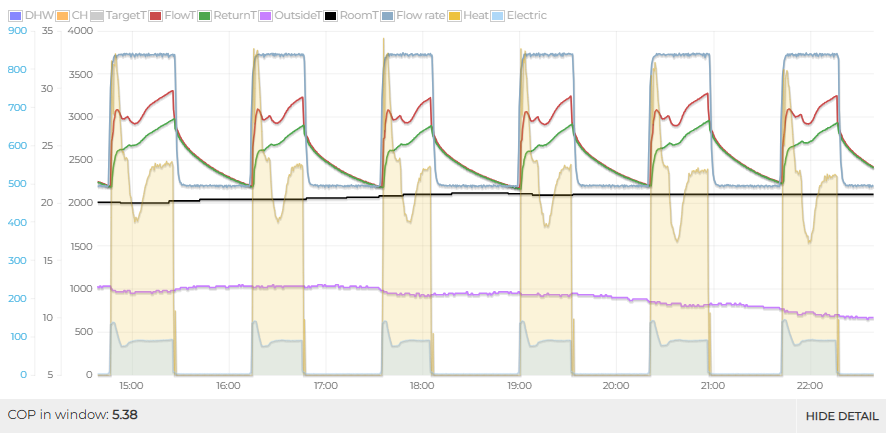
Whilst the flow rate is indeed fixed within the calculation, the flow rate can change on the Arotherm during normal operation.
When running inactive or active room temp mod mode, you will see the heat pump vary the pump speed whilst cycling.
In the “on” period the flow rate target a higher reading, then during the “off” portion of the cycle the heat pump will drop the flow rate, but still distribute the water around the system.
Note: I covered cycle behaviour depending on mode in SensoCOMFORT Room Temp Mod: Inactive, Active or Expanded?
You can see the flow rate change in this Open Energy Monitor snippet from my own system (the blue line).
https://emoncms.org/energystatsuk?mode=power&start=1740148720&end=1740177540&flow=1
How to change pump speed on a Vaillant Arotherm
On the Vaillant Arotherm you can have different flow rates for heating and hot water (and cooling for that matter).
You can alter the pump speed via the VWZ AI Heat Pump Controller (white box), but you’ll need to go into the Installer Menu.
- Press both upper buttons at the same time to get to the menus.
-
The default code to access the installer menu is 17
Once in there, go to to Configuration and the menu items are:
- Conf. heat. build. pump
- Conf. cool. build. pump
- Conf. DHW. build. pump
You can set these in the range 50% to 100% or Auto.
Auto normally tries to get you to 860 L/h, 1200 L/h or 2000 L/h, depending on your model.
Be careful. The installer menu contains settings that can affect your whole system. If you don’t know what you’re doing, stay out of there.
Disclaimer: I accept no responsibility for any issues you run into by poking about with settings. With great power comes great responsibility.
Simple mass flow rate triangle calculator
This calculator shows how flow rate, DT, and heat output (kW) relate. The three sides of the mass flow rate triangle.
You can set which value you want to solve for, then enter the other two along with your specific heat capacity (SHC).
Flow conversions between L/h, L/min, and L/s update automatically as you type.
Mass flow rate triangle calculator
Set the variable to solve for, then enter the other values. Flow conversions update automatically.
How to measure flow and return on a Vaillant Arotherm
You don’t need any fancy equipment to read the current flow and return values from your heat pump.
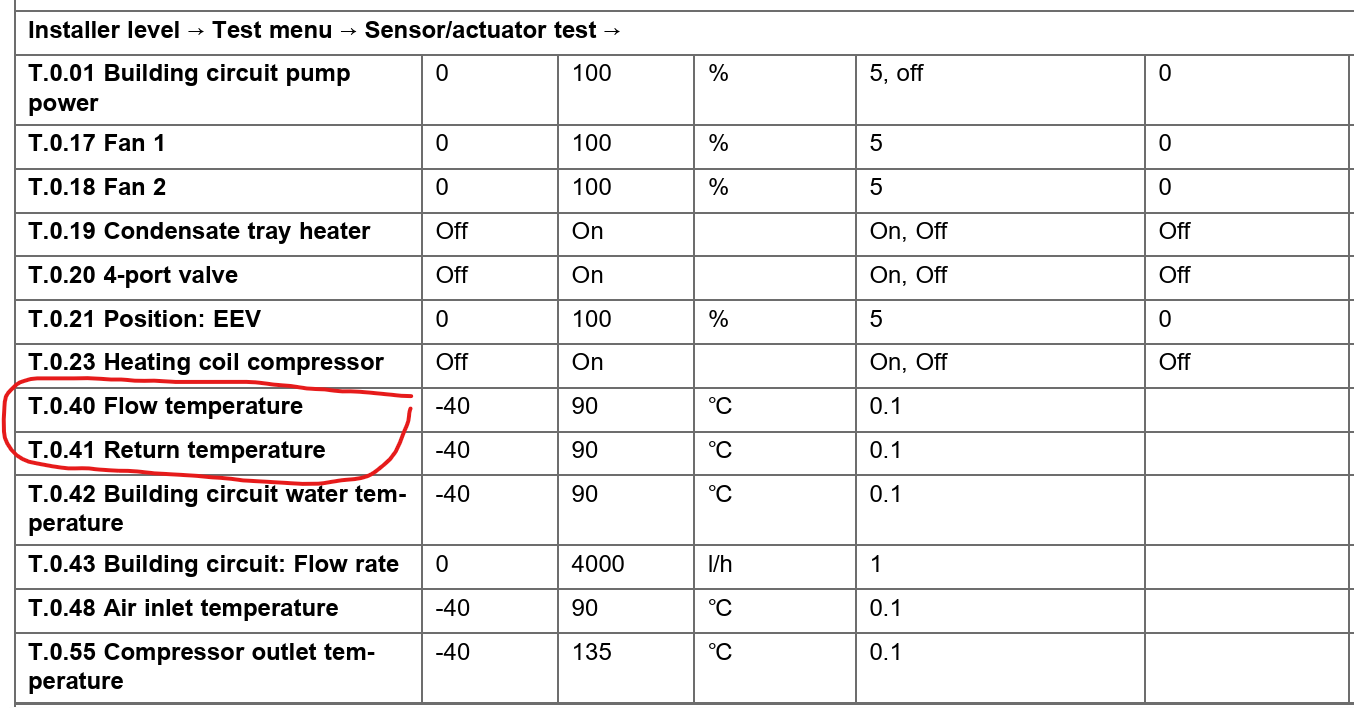
Flow, Return and whole host of other useful metrics can be viewed via the VWZ AI Heat Pump Controller (white box).
- Press both upper buttons at the same time to get to the menus.
-
The default code to access the installer menu is 17
Once in there, go to Test menu and find:
- Flow Temperature
- Return Temperature
Below is a screen grab from the VWZ AI user manual showing some of the other metrics you can see in that test menu.
How to see DT live with a heat meter and Open Energy Monitor
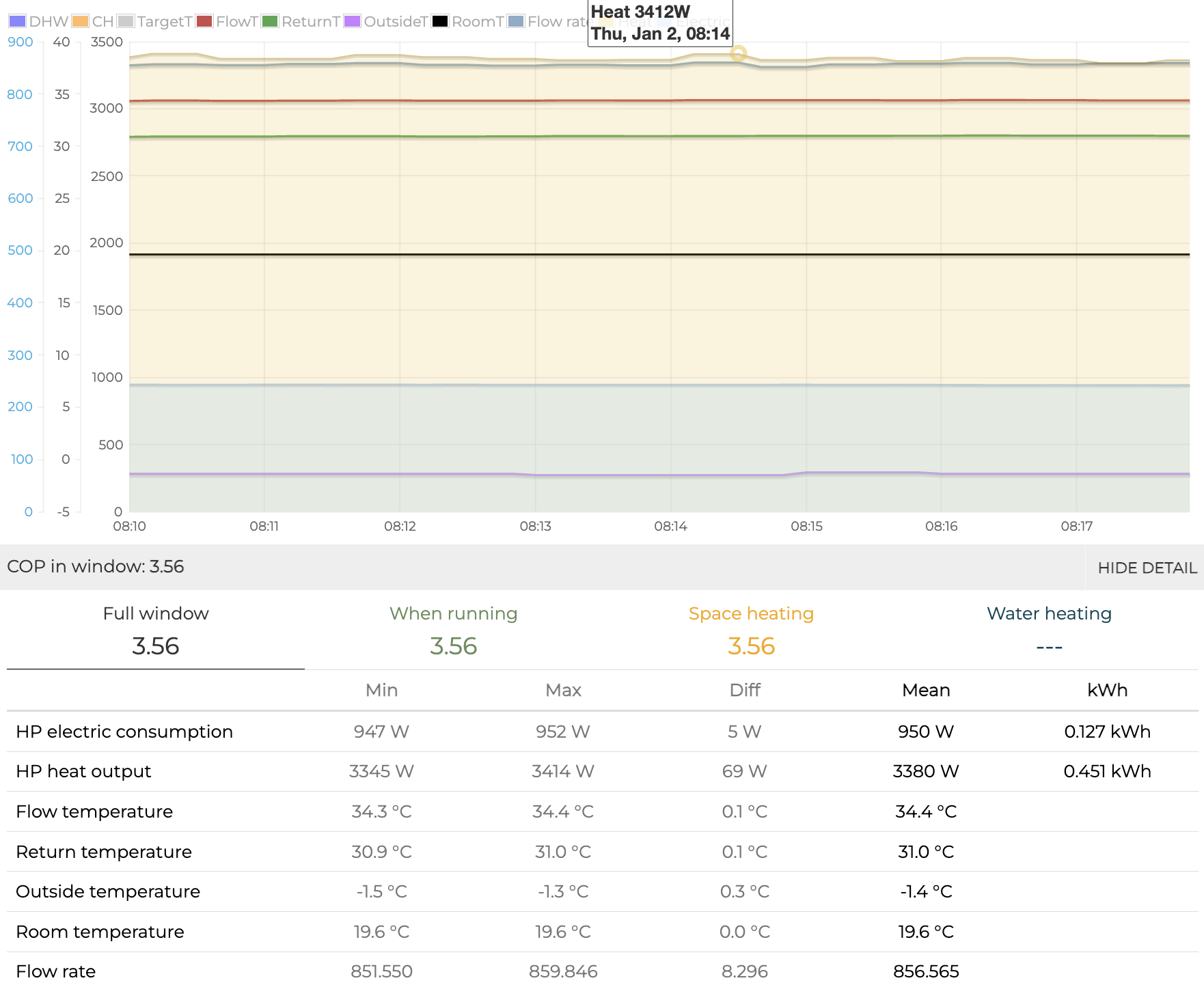
If you have a heat meter connected to an Open Energy Monitor setup, you can see the mass flow rate triangle play out in real time.
You’ll watch the flow rate, flow and return temperatures, and DT, which makes it easy to understand how the system reacts to changing demand.
In this example we have the following
- Flow: 34.4
- Return 31.0
- DT: 3.4 (34.4 – 31.0)
- Flow Rate: 860 L/h (0.239 L/s)
- SHC: 4.2
So the calculated output is 3.4kW and indeed, that is what we see on the Open Energy Monitor trace.
https://emoncms.org/energystatsuk?mode=power&start=1735805400&end=1735805870&flow=1
Heat pump training courses to understand DT and mass flow rate
If you want to go further and really understand what’s happening inside your system, these are worth a look:
Next subject to look at: once you understand mass flow rate, it’s worth learning about the importance of velocity and pipe sizing in your heating circuit.
This video from Lewis Litherland at Heat Geek helps explain how velocity affects performance and system design:
👉 Watch Lewis Litherland explain velocity in hydronic systems
Summary
-
On Vaillant aroTHERM systems, flow rate is fixed, so DT varies with heat demand.
-
Mild weather = narrower DT, cold weather = wider DT.
-
SHC is constant, so on systems where DT is fixed, it’s the flow rate that must change instead.
-
Installing a heat meter helps you see this in real time and confirm your heat pump is running as it should.
Frequently asked questions about DT and mass flow rate
Should my Vaillant heat pump always run at DT5?
No. The idea that all heat pumps should run at DT5 is a myth. On a Vaillant aroTHERM, the flow rate is fixed, so DT naturally changes depending on heat demand. You’ll see a lower DT in mild weather and a higher DT when it’s cold.
What’s a normal DT for a Vaillant heat pump?
Anything between about 2 K and 6 K is normal, depending on outdoor temperature and heat demand. Don’t worry if yours fluctuates.
Why is DT different on other heat pumps?
Some heat pumps have fixed DT control instead of fixed flow. When DT is fixed, the unit varies the pump speed (and therefore flow rate) to maintain that target temperature difference.
Does glycol affect DT or flow rate?
Yes, slightly. Glycol has a lower specific heat capacity than water (around 3.8 instead of 4.2), so it carries a bit less energy per litre. That can make your DT readings slightly wider for the same heat output.
Referral information and free credit offer
If you find Energy Stats UK useful, there are a couple of easy ways to support the site and help cover hosting and server costs.
Thinking about switching energy suppliers?
Homeowners who join Octopus Energy using my referral link get £50 free credit after signing up. Business users get £100 free credit, and if you’re looking at solar or a heat pump, there’s also a £100 gift card through Octopus Tech.
Finally, a £25 gift card can be claimed when having an EV charger installed through Octopus.
“Existing Octopus customer? Find out how you can benefit too. T&Cs apply (only one switching offer per household)”
You can switch to E.ON Next with this code and switch to EDF (FreePhase) with this code.
Or, if you just want to say thanks, you can buy me a coffee.
You can also see more ways to support the site here via the likes of Plusnet broadband, Smarty Mobile, Havenwise remote heat pump control, Axle Energy, Quidco and more.
If you are thinking about a heat pump, check out my dedicated Trusted Heat Pump Installers website along with my guide How to Choose a Heat Pump Installer.
Follow @energystatsuk on Twitter / X, Bluesky and Mastodon for daily tariff graphs and updates.
Also, check out my Energy Unwrapped Podcast and please subscribe to my YouTube channel where podcast episodes and video articles will be published.
Note: The current and past performance of energy pricing is not necessarily a guide to the future.


One Comment